When an agent in Canggu or Ubud emails you a document called an SPA, the English label tells you surprisingly little. In Indonesia, those three letters can describe a preliminary PPJB, a formal AJB transfer deed signed before a land deed official, or a lease that never transfers land at all. Each carries different rights, taxes and risks. Knowing which document you are holding, before any money moves, is one of the most useful protections an Australian buyer has.
An Indonesian property sale and purchase agreement sets the terms of a transaction, but its legal effect depends on the property right and document used. Australian buyers should distinguish a preliminary PPJB from an AJB transfer deed and a lease agreement, then obtain independent checks before signing or releasing funds.

What Does an Indonesian Property SPA Actually Mean?
SPA stands for sale and purchase agreement, but in Indonesia it is a commercial label rather than a defined legal category. An Indonesian property SPA is whatever its contents and form make it: a preliminary contract, a land transfer deed or a lease. Agents, developers and private sellers use the English term loosely, so your first job is to identify which instrument is actually on the table.
PPJB: the preliminary binding agreement
A PPJB (Perjanjian Pengikatan Jual Beli, roughly a binding agreement to sell and buy) sets out the price, payment schedule, conditions and timetable for a future transfer. It is used when the transfer cannot happen yet, for example because a certificate is being split, the price is being paid in instalments or the building is unfinished. A PPJB is often signed before a notary, but it creates contractual obligations rather than a registered land right.
AJB: the transfer deed
An AJB (Akta Jual Beli, a deed of sale) is the formal deed used to transfer a registrable land right such as Hak Guna Bangunan or Hak Pakai. It is executed before a PPAT (Pejabat Pembuat Akta Tanah, a land deed official authorised for the area), and the transfer is then registered at the land office of ATR/BPN, Indonesia’s national land agency.
Lease agreements: use, not ownership
A lease agreement (perjanjian sewa, connected to Hak Sewa, the right to lease) gives you use of land and buildings for an agreed term while the landowner keeps the certificate. Most “leasehold villas” marketed to Australians in Canggu, Seminyak or Ubud are contracts of this kind.
| Document | Main purpose | Legal effect when signed | Typical next step |
|---|---|---|---|
| PPJB | Lock in the terms of a future sale | Contractual rights and obligations; no completed registered transfer | Satisfy conditions, then sign an AJB before a PPAT |
| AJB | Transfer a registrable land right | Formal transfer deed; registration with ATR/BPN follows | PPAT submits the deed and the land records are updated |
| Lease agreement | Grant use of land and buildings for a fixed term | Contractual right to occupy and use; the landowner keeps title | Pay rent, take possession, manage extension and expiry terms |
These documents are not interchangeable. A lease labelled “SPA” does not become a sale, and a PPJB does not become a transfer simply because a notary was involved. It also helps to know what kind of notary involvement you are getting. An authentic notarial deed (akta autentik) is drawn up by the notary in the statutory form, and Indonesian law gives it strong evidentiary weight as proof of what the parties declared and when. Signature legalisation (legalisasi) is weaker: the notary confirms who signed a privately drafted document and on what date, but does not author its contents. Registration (waarmerking) only records that a private document existed on a given date. None of these, not even an authentic deed, makes an ineligible buyer eligible to hold a land right.
Step 1: Confirm the Right You Can Acquire
Before reading a single clause, establish what you can lawfully acquire. The answer depends on who is buying, you personally or a company, and on the land right attached to the property.
An Australian individual cannot hold Hak Milik, Indonesia’s strongest land right, which is recorded on an SHM (Sertifikat Hak Milik) certificate. Under the Basic Agrarian Law (Law 5/1960), Article 21 reserves Hak Milik for Indonesian citizens, and Article 26(2) treats a transfer of Hak Milik to a foreigner as void by law, with the land falling to the State (as at October 2026). Sounds great on Instagram, but here’s the reality: an SHM villa can only reach you through a lease, or through a right you are actually eligible to hold, such as Hak Pakai granted over that land.
For a personal purchase, the realistic routes are a contractual lease (Hak Sewa) or, for a foreigner who meets the immigration-document requirements, a residential house on Hak Pakai (right of use) land. Government Regulation PP 18/2021, in force since 2 February 2021, sets the framework for foreigners’ residential ownership, including minimum price thresholds set by the land ministry.
Term lengths depend on what sits underneath the right, and this is where many listings get it wrong. As at October 2026, PP 18/2021 provides:
- Over State land or Hak Pengelolaan (HPL, a management right) land: under Article 37 for HGB and Article 52 for fixed-term Hak Pakai, the right is granted for up to 30 years, may be extended for up to 20 years, and may then be renewed for up to 30 years. On HPL land, extension and renewal also need the HPL holder’s approval.
- Over Hak Milik land: under Article 37(2) for HGB and Article 52(2) for Hak Pakai, the right is granted for up to 30 years and continues only through a new grant deed agreed with the Hak Milik holder and registered again. There is no statutory 20-year extension stage in between, so your future depends on the landowner signing a fresh deed.
In neither case are extension or renewal automatic. They depend on conditions such as the land still being used for its granted purpose, you remaining an eligible holder, your obligations being met and, where relevant, the HPL holder’s or landowner’s consent. Still to confirm for your deal: any amendments since October 2026, the price threshold for Bali, your required documents and whether this specific property qualifies. Your lawyer and PPAT can check the regulation text in the ATR/BPN legal documentation database. Strata apartments follow separate rules on which underlying right qualifies, so treat them as their own question.
Company ownership is a different path entirely. A PT PMA, an Indonesian limited liability company with foreign shareholders, can hold Hak Guna Bangunan (HGB, a right to build and hold buildings on land) where its licensing and business activity support that use. The company owns the property, not you. It must meet capital and investment requirements, keep licences current, file tax returns and lodge regular investment reports. A PT PMA formed purely as a shell for a holiday home is a costly and fragile foundation.
Nominee arrangements, where an Indonesian citizen holds Hak Milik on your behalf under side agreements, are not a safe substitute for lawful eligibility. The paperwork can look reassuring, but the structure contradicts the law it tries to work around, and your position rests on the nominee’s goodwill and on a court’s view of an arrangement designed to avoid the law.
Keep three questions separate: which property right you can hold, what immigration permission allows you to stay in Indonesia (check the current visa and stay permit rules with Indonesia’s Directorate General of Immigration), and whether you are authorised to run a rental business. A valid lease answers only the first.
Step 2: Check the Seller and Property Evidence
First thing I check on any villa is whether the person selling actually controls what they are selling. In Indonesia that means matching names, certificates, consents and permits, then deciding who is responsible for each check. The matrix below links each issue to its evidence, the right reviewer, the payment it should unlock and what happens if the issue stays unresolved.
| Issue | Evidence to request | Who reviews it | Payment-release condition | Consequence if unresolved |
|---|---|---|---|---|
| Seller identity | KTP (Indonesian ID card), family card or passport, with names and ID numbers matching the certificate exactly | Independent lawyer; notary/PPAT at signing | No deposit until the lawyer confirms in writing that the identity matches the certificate holder | Payment to someone without power to sell or lease |
| Company or representative authority | Deed of establishment, amendments, director or shareholder approvals, power of attorney | Independent lawyer | Signing and deposit only after written confirmation that the signatory is authorised | Agreement signed by an unauthorised person; enforceability disputes |
| Spouse or heir consent | Marriage records, written consents, inheritance documents for jointly held or inherited land | Lawyer; notary/PPAT | Each instalment withheld until signed consents are on file | Later challenge by a spouse, co-owner or family members |
| Land certificate | Original SHM, HGB or Hak Pakai certificate and an official ATR/BPN check result | Notary/PPAT with the land office; lawyer reviews the result | Main payment released only after a clean check dated within an agreed window before completion | Certificate disputed, mismatched or not as described |
| Encumbrances | Land office records of mortgages (Hak Tanggungan), blocks or registered disputes | PPAT; lawyer | Funds held back until any mortgage is discharged or paid out directly at completion | A lender or claimant’s rights rank ahead of yours |
| Boundaries and area | Certificate map compared with an on-site survey | Surveyor or technical inspector | Survey sign-off required; agreed price adjustment if area falls short | Buildings over the boundary or a smaller parcel than paid for |
| Legal access | Road frontage or a documented access agreement | Lawyer; inspector | No completion until access is documented in a form that binds future owners | A villa reached only by a neighbour’s permission |
| Zoning | Spatial plan and confirmation of permitted use (KKPR) for the parcel | Lawyer; planning specialist | Written confirmation that your intended use is permitted before deposit release | Intended use not permitted; permit problems |
| Building approval | Building approval (PBG), or a valid legacy IMB permit for older buildings, compared against the approved drawings and any later additions | Lawyer; technical inspector establishes the building’s approval history | Instalment withheld until the inspector confirms the building matches its approval | Unapproved structures, enforcement risk, regularisation costs |
| Fitness for use | Certificate of fitness for use (SLF) where required, checked separately from the PBG or IMB | Technical inspector; lawyer | Completion conditional on a current SLF, or an agreed seller obligation and retention if one is missing | Building not cleared for its current use; licensing difficulties |
| Intended rental use | Business licensing through the OSS online system and any operator arrangements | Lawyer; licensing adviser | Confirmation of a lawful licensing route before you commit to a rental-based price | Short-term letting without proper authorisation |
A note on the permits: an older IMB can still evidence that a building was approved, but it does not answer whether the building is currently cleared for use. That is the SLF’s job. Ask your reviewer to confirm both, and to check whether extensions or a converted garage were ever approved at all.
Here is how the matrix turns into contract terms, as a hypothetical example: a 10% deposit is held by the notary under a written custody arrangement. It is released to the seller only when your lawyer signs off on seller authority and the PPAT delivers a clean ATR/BPN certificate check, both within 21 days of signing. If either sign-off is missing by day 21, the notary refunds the full deposit within 14 days. The next instalment is released only after the technical inspector’s PBG and SLF report. Named person, named document, deadline, consequence.
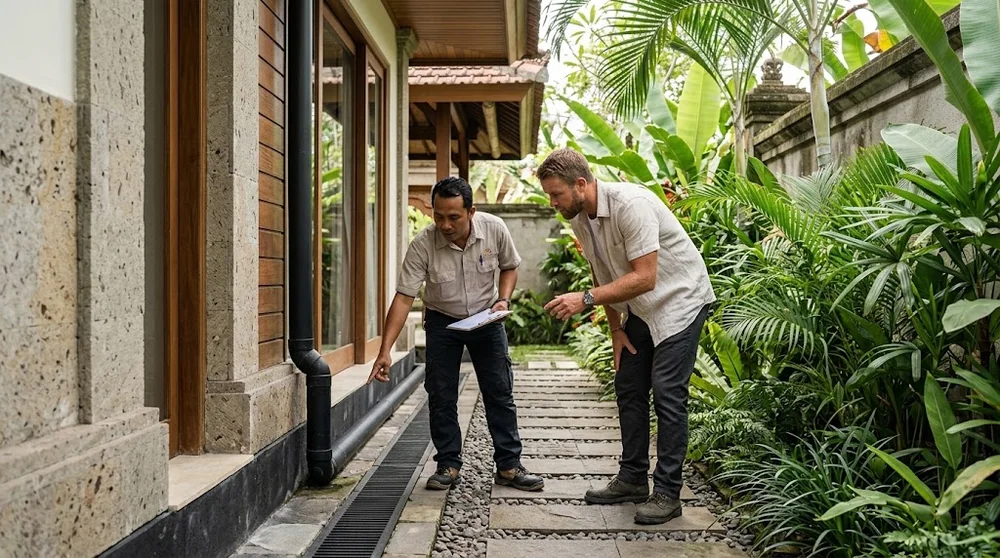
The professionals involved do different jobs. An independent Indonesian property lawyer acts for you, assesses eligibility and negotiates protections. A notary prepares and certifies notarial deeds such as a PPJB or a lease, while a PPAT prepares the AJB and handles the registration paperwork; both perform formal public functions rather than acting as your advocate. A technical inspector or surveyor checks the physical building, boundaries, drainage and access against the documents.
Building and managing my own rental villa made one thing very clear to me: a clean certificate says nothing about a leaking roof, a drainage line that floods the neighbour or a driveway that sits on someone else’s land. Paper checks and physical checks need each other.
Step 3: Negotiate Conditions Before Paying
Australian buyers often arrive expecting a conveyancing system with statutory deposit trust accounts and a cooling-off period. Do not assume either applies in Indonesia. Before payment, your protection comes mainly from what you negotiate in writing and from who actually holds your money.
Conditions precedent are events that must happen before you are obliged to pay or complete. Typical examples include satisfactory legal due diligence, a clean ATR/BPN certificate check, confirmation that the PBG matches the building, written spouse or heir consent and, for leases, signed extension terms from the landowner. Many deals start with a reservation or booking form. Read it as carefully as the main agreement, because it may contain a non-refundable fee, an exclusivity period or a deadline that quietly converts into a forfeited payment.
Before any deposit leaves your account, have your lawyer settle these points in writing:
- Deposit custody: state exactly who holds the money and on what terms. A notary or another third party may agree to hold funds under a specific written arrangement, but that is a negotiated arrangement, not a statutory escrow guarantee.
- Verified payee: pay only into an account in the name of the contracting party or the agreed custodian, and confirm the details by phone through your lawyer rather than relying on an emailed change of bank details.
- Release instructions: list the documents, sign-offs and events that allow each payment to be released, so money moves only when evidence exists.
- Refund triggers: name the failed conditions that entitle you to a refund, such as an unclear certificate, missing consent or permits that do not match the building.
- Refund deadline and deductions: set a number of days for repayment and specify any permitted deductions, ideally none beyond clearly agreed costs.
- Notices and dispute route: define how notices are given, in which language, to which address, and which court or arbitration body hears disputes.
Nine years in Bali have taught me that a refund clause is only as strong as the other party’s ability to repay. If a seller has already spent your deposit, recovery may mean lengthy proceedings in Indonesia and then a separate effort to enforce the result. An arbitration clause or a notarised deed can improve your position, but neither removes the practical risk of chasing money, so the safest deposit is a modest one held by a properly instructed third party.
Step 4: Review the Essential SPA Clauses
A well-drafted agreement links every protection to evidence and to a payment event. This section is a review guide, not a template; your lawyer must tailor each clause to the land right, the parties and the payment structure of your deal.
- Parties: full legal names, identity numbers, marital status, company details and the authority of anyone signing on behalf of another person or company.
- Property description: certificate type and number, land area, location, building description and an annexed site plan that matches the survey.
- Fixtures and contents: an inventory annex listing furniture, pool equipment, air conditioners and anything else included in the price.
- Price and currency: the price, instalments and payment dates. Law 7/2011 on Currency, Article 21, generally requires rupiah for transactions carried out in Indonesia (as at October 2026), so ask your lawyer how the price should be expressed and who carries exchange-rate movements.
- Taxes and fees: which party pays each tax, notary and PPAT fees, and agent commission, stated for the specific instrument being signed.
- Representations: seller statements that there are no undisclosed disputes, encumbrances, unpaid taxes or permit problems, together with remedies if those statements prove false.
- Completion conditions and deadlines: each condition, the evidence that satisfies it, the person who signs it off, the date it must be met and a long-stop date after which either party may withdraw.
- Payment release: a schedule tying each instalment to the sign-offs in the Step 2 matrix, with the custodian instructed to withhold funds until they arrive.
- Possession and risk: when keys pass and who bears the risk of damage, flooding or fire before that date.
- Default and cure: what counts as default, the notice required and a cure period before termination is allowed.
- Termination and refunds: the consequences of termination for each party, including repayment timing and any agreed compensation.
- Governing law and dispute resolution: Indonesian law will usually govern land matters; the choice between Indonesian courts and arbitration affects cost, speed and enforcement.
Two drafting details deserve specific attention. Many Indonesian contracts include a waiver of Civil Code Article 1266 so that termination does not require a court ruling; ask your lawyer whether that waiver helps or hurts you in this deal. Also check that the representations survive completion, because problems with land often surface only after the money has gone.
A clause protects you only when it names the evidence, the responsible person and the consequence if that evidence never arrives. Vague promises such as “the seller will arrange permits” without a deadline or remedy leave you with an argument rather than a right.
Step 5: Match Lease and Construction Terms
The agreement must match the type of deal you are actually doing. An existing villa, an off-plan project and a lease assignment each raise different questions, and a mismatch between contract duration and land-right duration is one of the costliest errors in Bali.
Existing villa
Check the remaining lease term against the exact commencement and expiry dates in the lease, not the listing. Let’s run the numbers properly with a hypothetical: a 25-year lease that commenced on 1 March 2016 expires on 28 February 2041. If you complete on 1 November 2026, you are buying 14 years and 4 months, not “25 years”, however the brochure puts it.
Then look at the extension wording, because two very different things get called an “extension right”. A binding extension option obliges the landowner to grant a further term if you give notice by a set date, at a fixed price or a defined formula (for example, the original price indexed to a named inflation measure). A “first right to extend” or “priority to negotiate” usually only means the owner must talk to you first; if you cannot agree on price, you may walk away with nothing. “To be negotiated” gives the landowner most of the leverage. Confirm subletting rights for holiday rental, who owns the buildings at expiry and whether the lease passes to your heirs on death.
Off-plan project
Annex a detailed specification, tie each instalment to a milestone confirmed by an independent inspector, and set a long-stop date with refund rights. Include a defects liability period and practical remedies such as retention money. Indonesian housing law sets prerequisites for developers who market and sign PPJBs for homes still under construction, covering matters such as land status, approvals and construction progress; whether this developer meets them is a project-specific question your lawyer must check. Confirm that the developer’s own land right or head lease outlasts your contract.
For off-plan leaseholds, pin down when the lease clock starts. If the term runs from signing, every month of construction eats into the years you actually get to use. I’ve seen this mistake more times than I can count: a buyer signs a 30-year lease, the build runs 18 months late, and those lost years are simply gone. Ask for the term to start at handover of a completed villa, or at least at land access, and for the contract to state who bears delay. A common fix is extending the expiry date day for day for any delay beyond the agreed completion date, backed by the landowner’s signature, not just the developer’s.
Lease assignment
When you take over an existing lease from another foreigner, you can receive no more than the assignor holds. Obtain the original lease and every amendment, confirm that assignment is permitted, secure the landowner’s written consent, and check for unpaid rent, taxes or disputes before signing the assignment deed.
My view, after years of working with leasehold villas: the remaining term and the extension mechanism usually matter more to long-term value than the furniture package or the pool. Read those clauses first.
Step 6: Reconcile Both Language Versions
Law 24/2009 Article 31(1) requires Indonesian to be used in agreements involving Indonesian institutions, private entities or citizens. Article 31(2) adds that where a foreign party is involved, the agreement is also written in that party’s national language and/or English (as at October 2026). So for an Australian buyer, the expected outcome is a bilingual document, not an English contract with an optional translation.
What happens when the Indonesian version is missing has shifted over time. Supreme Court Circular SEMA 3/2023 guides judges that an agreement should not be annulled merely because it was not made in Indonesian, unless it is proven that the omission stemmed from a party’s bad faith. That guidance limits one argument used to escape contracts; it does not remove the statutory requirement to use Indonesian, and a court still looks at the circumstances of each case. Do not assume that an English-only contract is automatically void, do not assume it is automatically safe, and do not assume the Indonesian text always prevails. Ask your lawyer how the requirement applies to your specific instrument, then work through these steps:
- Request the Indonesian version at the start of negotiations, not on signing day, so both texts develop together.
- Have a qualified bilingual lawyer compare each draft round, because changes agreed in English do not always reach the Indonesian text.
- Check every annex in both languages, including the specification, inventory, payment schedule and site plan.
- Read the discrepancy clause that states which version governs if the texts differ, and confirm that it suits you.
- Review the final notarial deed or PPAT deed, which is generally prepared in Indonesian, and ask for a translation well before the appointment.
- Use a sworn translator (penerjemah tersumpah) for foreign documents, powers of attorney and anything filed with an authority where certified translation is required.
Matching drafts are worth the extra time, because a translation gap discovered after signing becomes a dispute rather than an edit.
Step 7: Budget and Arrange Signing
Separate four cost groups: the contract price, taxes, professional fees, and bank and foreign-exchange costs. Taxes depend on the instrument. A registrable transfer typically involves the buyer’s BPHTB (land and building acquisition duty) and the seller’s final income tax on the transfer, while new property bought from a developer may involve VAT. A lease follows different rules, including tax on the landowner’s rental income, and registered-transfer taxes should never be applied automatically to a lease. Rates, thresholds and Bali regional rules change, and whether any tax liability could arise from the PPJB itself is a deal-specific question, so this guide does not quote rates. Before signing a PPJB, have your adviser confirm the current national rules published by Indonesia’s Directorate General of Taxes and the regional rules, and record in the contract who pays each tax.
Let’s run the numbers properly: assume a hypothetical A$300,000 budget. At an assumed IDR 10,000 per Australian dollar, that equals IDR 3 billion; at an assumed IDR 9,000 per dollar, it equals IDR 2.7 billion. If the price is fixed at IDR 3 billion and the rate falls from 10,000 to 9,000, you would need about A$333,333, roughly A$33,333 more. These are invented sensitivity assumptions, not current exchange rates or purchase quotations. Add transfer fees and conversion margins from your own bank.
Remote signing is instrument-specific. A power of attorney signed in Australia usually needs notarisation, an apostille (the Apostille Convention has applied to Indonesia since 4 June 2022) and a sworn Indonesian translation, but some notaries and PPATs require a particular format or personal attendance for certain deeds. Confirm the requirements for each document before booking flights or transferring funds.
Your Australian tax residency affects how foreign rental income, capital gains and any foreign tax paid are treated, and buying personally versus through a PT PMA can change the outcome significantly. ATO guidance on foreign income is a starting point, but obtain advice from a registered Australian tax adviser before signing, and keep records of every payment, exchange rate and cost from day one.
Got a draft SPA or a listing and not sure which document you’re actually looking at? Message Jack on WhatsApp for a plain-English first read before you talk to your lawyer.
Step 8: Complete and Verify the Outcome
Completion looks different for a registered land right and for a lease. Signing is not the finish line; the outcome is verified only when the right records, receipts and handover documents are in your hands. AJB execution and land registration are separate stages, so ask your PPAT to explain what each stage achieves for your specific transaction.
Registered-right transfer
- Confirm that every PPJB condition is satisfied and that a final ATR/BPN certificate check is clean.
- Pay the applicable taxes and keep official payment evidence for both buyer and seller obligations.
- Sign the AJB before the PPAT, with your lawyer having reviewed the final Indonesian text.
- Ask the PPAT to confirm when the deed was submitted to the land office and to provide a receipt or reference.
- Collect the updated certificate and check the holder’s name, right, area and expiry date.
Lease completion
- Execute the lease or assignment deed with all annexes signed or initialled in both languages.
- Obtain receipts for every rental payment and copies of landowner, spouse or heir consents.
- Take lawful possession with a dated handover report, photographs, keys, meter readings and utility account transfers.
- Record defects and agreed rectification dates, and keep warranties and as-built documents.
A contractual lease does not put a land certificate in your name, so do not expect title registration as the end point. Keep certified copies, digital backups and a calendar of renewal and extension deadlines, including the notice date for any extension option.
Not sure whether you’re ready to sign? Take Jack’s quick pre-signing quiz and see which checks you still need to tick off.
Your Pre-Signing Decision Checklist
Use this as a stop-or-proceed test. If any answer is “no” or “not sure”, pause before signing or paying.
- Eligible right: you can lawfully hold the right being offered, personally or through a genuinely operating PT PMA, and you know whether it sits over State, HPL or Hak Milik land.
- Verified authority: the seller or landowner, their spouse or heirs, and any representative have documented power to sign.
- Checked evidence: certificate, encumbrances, boundaries, access, zoning, building approval, SLF and rental licensing have each been reviewed by the right professional.
- Matched drafts: Indonesian and English versions, annexes and the final deed say the same thing.
- Protected payments: deposit custody, verified payees, release instructions and refund deadlines are written down.
- Defined remedies: default, cure, termination and dispute resolution are clear.
- Documented closing route: you know which deed, registration step or handover completes your transaction.
Your practical next step is to send the draft agreement, the reservation form and a certificate copy to an independent Indonesian property lawyer before paying anything at all, including a reservation fee. That review should cover the reservation terms themselves and who will hold the money. This guide is general information, not legal, tax or financial advice. Statutory references are stated as at October 2026; project-specific points flagged above remain open until your own advisers confirm them against current official texts.
Indonesian Property Agreement FAQs
What is the difference between a PPJB and an AJB?
A PPJB is a preliminary binding agreement that sets the price, conditions and timetable for a proposed sale. An AJB is the formal sale deed prepared and executed through the appropriate PPAT process for a registrable land-right transfer, followed by registration with ATR/BPN. Neither term should be applied automatically to a lease, which follows a different contractual route.
Does signing a PPJB mean I own the property?
Signing a PPJB does not, by itself, complete a registered land-right transfer. It creates contractual commitments, which can include substantial payment obligations before completion. Your lawyer and PPAT should explain the remaining conditions, the required AJB and registration steps, and confirm that you are actually eligible to acquire the specific land right being offered before you pay.
Can an Australian buy freehold property in Indonesia?
An Australian individual cannot directly hold Indonesian Hak Milik land ownership, recorded on an SHM certificate. Depending on eligibility and the property, alternatives may include a contractual lease or Hak Pakai. A qualifying PT PMA may hold other permitted rights such as HGB, with separate corporate obligations. Avoid nominee arrangements presented as a substitute for lawful eligibility.
Does my Indonesian property agreement need an Indonesian version?
Law 24/2009 Article 31 requires Indonesian in agreements involving Indonesian parties, and where a foreign party is involved the agreement is also written in that party’s language and/or English. SEMA 3/2023 limits annulment for a missing Indonesian version to cases of proven bad faith, but the requirement still stands. Have an independent bilingual professional compare both versions, every annex and the final deed before signing.
Can I recover my deposit if the property checks fail?
A failed property check does not automatically guarantee a deposit refund. Recovery depends on the agreement, applicable law, who holds the money and the seller’s ability to repay. Before payment, negotiate clear conditions, refund triggers, deadlines and release instructions, then have an independent Indonesian lawyer assess how those protections would work in practice.
Do I need my own lawyer if a notary is involved?
Independent legal advice serves a different purpose from the formal work of a notary or PPAT. Your lawyer can assess eligibility, negotiate protections and review the transaction from your perspective. Confirm each professional’s appointment, qualifications and scope rather than assuming the person preparing the deed also represents your individual interests in the transaction.
Fazit
An Indonesian property SPA is only as safe as the right behind it. Work out first whether you are holding a PPJB, an AJB or a lease, then confirm you can lawfully hold what is on offer and what the land underneath means for your term: a right over State or HPL land runs on a 30-20-30 pattern, while a right over Hak Milik land depends on the owner granting a fresh deed after 30 years.
Money should move only against evidence. Get independent advice before any payment, reservation fees included, and tie every instalment to a named document, a named reviewer and a deadline, with a refund if the evidence never turns up. In my experience, the buyers who end up happy in Bali are the ones who spent a few extra weeks on checks rather than a few extra dollars on the furniture package.
Finally, don’t treat signing as the finish line. Collect the land office receipt and updated certificate, or the signed lease, consents and handover report, and diary every extension deadline. Rules quoted here reflect my understanding as at October 2026, so have an independent Indonesian lawyer and a registered Australian tax adviser confirm them for your deal.
Disclaimer: This article provides general information about Indonesian property agreements for Australian buyers. It is not legal, tax, immigration or financial advice, and it does not guarantee any outcome. Obtain advice from an independent Indonesian property lawyer, an appropriately appointed notary or PPAT, and a registered Australian tax adviser before signing or paying.