Picture morning coffee on your own terrace near Canggu, the surf report open and the next school-holiday trip already pencilled in. Then the seller asks for 10% to “secure” the villa, and the daydream becomes a legal and financial decision. I’m Jack, a Perth expat who has spent around nine years in Bali building and managing my own rental villa. This guide explains what that deposit can and can’t do before you send it.
A 10% deposit on Bali property may reserve a villa or form part of the agreed price, depending on the contract. It does not establish ownership or guarantee a refund. Before paying, verify the property rights, coastal restrictions, recipient account, refund conditions and remaining payment obligations with an independent Indonesian lawyer.

What a 10% Deposit on Bali Property Secures
When a listing promises that 10% will “secure” a villa, that word is doing a lot of quiet work. A deposit on Bali property secures only what the signed agreement says it secures. At best, that means a named villa or plot taken off the market for a defined period, at an agreed price, with the money credited towards that price. At worst, it means a receipt for money with vague promises attached.
Reservation: taking a specific villa off the market
A reservation is a commercial promise by the seller or developer not to sell or lease the identified property to anyone else during an exclusivity period. The agreement should identify the property precisely: the unit or plot reference, the address, the land certificate number where available and the building or design being sold. It should also name every party who signs. A reservation signed by someone who is not the landowner, the lessor or an authorised developer may not bind the person who actually controls the land. Check how many days the exclusivity lasts, when it starts and what happens when it ends.
Price protection and deadlines
A well-drafted reservation fixes the agreed price for the exclusivity period and states in plain words whether the deposit will be credited towards that price. It should also set deadlines for completing due diligence, signing the main agreement and paying the next instalment. Each deadline needs a clear trigger and a clear consequence, because a missed date can affect either party’s rights.
Ownership: what a payment receipt does not give you
A deposit receipt is evidence of payment, not evidence of property rights. Paying 10% does not by itself transfer land rights, complete or register a lease, authorise holiday rentals, grant residence or visa rights, or make a beach private. It does not guarantee that construction will be finished.
That doesn’t mean you have no rights at all after signing. A signed reservation or conditional agreement can already create contractual rights and obligations on both sides: the seller’s promise of exclusivity, your obligation to pay by a deadline, and whatever refund or forfeiture terms the document contains. What it doesn’t give you is the lease itself or a registered land right. Those come from the relevant completed transaction documents and, where the right is registrable, registration with the land office.
The percentage itself also needs putting in its place. The 10% figure is a commercial term, not a legal requirement. I’m not aware of any Indonesian rule, as of October 2026, that sets 10% as a mandatory deposit for Bali property, and I can’t point you to verified data showing it as a market-wide average either. Sellers choose their own reservation amounts. Because the label is commercial, the refund consequences come from the contract and applicable law, not from the percentage. Your holiday plan becomes a contract the moment you sign, so read it like one.
Reservation Deposit, Down Payment or Construction Instalment?
Bali sellers use several labels for early payments, often loosely. In my experience, different sellers and developers ask for different first payments and stage the balance in different ways, which is a good reminder that these are negotiated terms rather than fixed rules. A payment label describes a commercial intention; it does not automatically decide whether the money is refundable.
| Payment | Usual purpose | Governing document | Credited to price? | Who holds it | Release trigger | Cancellation treatment |
|---|---|---|---|---|---|---|
| Reservation deposit / tanda jadi | Shows commitment and holds a named property for a stated period | Reservation form, booking agreement or MOU (memorandum of understanding) | Only if the document says so | Seller, developer or an agreed third-party holder | Signing the main agreement or satisfying stated conditions | Set by written conditions and applicable law; not automatically refundable or forfeited |
| Down payment / uang muka | First substantial payment towards the agreed price | Main agreement, such as a lease agreement or a PPJB | Normally intended as part of the price; confirm in writing | Seller, developer or holder under written instructions | Signing and agreed conditions being met | Decided by default, termination and refund clauses plus applicable law |
| Construction instalment | Funds building work in stages on an off-plan villa | Off-plan agreement and payment schedule | Credited according to the schedule | Developer, or a holder releasing on evidence | Independently verified construction milestone | Decided by delay, defect, default and termination clauses |
Tanda jadi loosely means a sign that the deal is on, while uang muka means a down payment. Neither term carries a guaranteed refund or forfeiture outcome on its own. The wording around the payment matters far more than the word on the invoice.
An MOU can be binding or largely non-binding depending on how it is drafted, so your lawyer needs to read the actual text. A PPJB (Perjanjian Pengikatan Jual Beli, a conditional sale and purchase agreement) is used in some transfers of registered land rights, but whether it suits your deal depends on the right being acquired. A leasehold contract is not automatically equivalent to a registered-right sale, and applying sale-transaction assumptions to a lease is a common source of confusion.
Run the Numbers Beyond the First 10%
Let’s run the numbers properly: the deposit is only one part of the commitment, and a modest-looking first payment can hide the size of what sits behind it. Take a hypothetical villa with an agreed price of IDR 5 billion (Indonesian rupiah). A 10% deposit is IDR 500 million, which leaves IDR 4.5 billion still to pay before any extra costs.
| Stage (illustrative example, not a quotation or market benchmark) | Share of price | Amount (IDR) | Cumulative share | Cumulative paid (IDR) |
|---|---|---|---|---|
| 1. Deposit, credited towards the price | 10% | 500 million | 10% | 500 million |
| 2. Main agreement signed | 30% | 1.5 billion | 40% | 2 billion |
| 3. Structural milestone verified | 30% | 1.5 billion | 70% | 3.5 billion |
| 4. Finishing milestone verified | 20% | 1 billion | 90% | 4.5 billion |
| 5. Handover after inspection | 10% | 500 million | 100% | 5 billion |
This illustrative example, not a quotation or market benchmark, counts the deposit once, as part of the price. Read schedules carefully: a 10% deposit followed by a 30% instalment brings you to 40% cumulatively, not 30%. If a contract describes a “30% milestone”, ask whether that means 30% of the price at that stage or 30% paid in total. And if the deposit is not credited, the true cost of the deal rises by the deposit amount.
The price is also not the whole bill. Budget separately for:
- independent legal review and due diligence by an Indonesian property lawyer;
- transaction-specific taxes, which depend on the right acquired and the structure, and should be confirmed by a tax adviser as of the transaction date (the Indonesian tax office, Direktorat Jenderal Pajak, publishes the official rules);
- notary or PPAT fees, technical inspection and any survey costs;
- furniture, fit-out and equipment not included in the price;
- insurance, if suitable cover is available for the property;
- ongoing maintenance, utilities, management and any local levies.
Currency is the other quiet cost. Most Australian and New Zealand buyers fund the deal from AUD or NZD, and banks and transfer providers apply a conversion spread on top of the exchange rate, so the rupiah amount that lands can be less than you expected. Over a staged schedule, each payment is exposed to the rate on its transfer date. Bank Indonesia Regulation PBI 17/3/PBI/2015, issued in 2015, generally requires the rupiah for transactions within Indonesia, subject to exceptions; I haven’t independently confirmed its amendment status as of October 2026, so ask your lawyer to check it. You can find the regulation and reference exchange rates on the Bank Indonesia website. A price advertised in US dollars or Australian dollars does not by itself create an exception. Ask your lawyer to confirm the lawful contract currency and settlement currency before you sign.
Check Leasehold Rights Before Paying
In my experience, most foreign holiday-home buyers I deal with in Bali end up with leasehold. First thing I check on any villa is the land right underneath the offer, because a lease is only as good as the lessor’s title. Here are the main structures in plain language, as of October 2026:
- Hak Sewa / leasehold: a contractual right to use land or a building for an agreed term in exchange for payment. It is usually documented by notarial deed, but notarising a lease contract is not the same as registering a land title.
- Hak Milik / SHM: Hak Milik is the strongest form of land right, evidenced by an SHM (Sertifikat Hak Milik, certificate of ownership). Foreign individuals cannot directly hold Hak Milik under Indonesia’s Basic Agrarian Law of 1960, as of October 2026.
- Hak Pakai: a right of use that some foreigners living in Indonesia may hold, subject to eligibility conditions your lawyer must confirm as of the transaction date.
- PT PMA / Hak Guna Bangunan: a PT PMA (a foreign-investment limited company) may hold HGB (Hak Guna Bangunan, a right to build and hold buildings for a term), subject to licensing, capital and reporting obligations that suit businesses more than casual holiday use. Investment licensing information is published by the Ministry of Investment (BKPM).
A nominee arrangement, where an Indonesian citizen holds Hak Milik for a foreigner, is not a safe substitute for a lawful structure. It leaves the foreign buyer relying on side agreements that may not be enforceable.
Land rights and registration are governed by Government Regulation (PP) 18/2021, issued in 2021 and administered by ATR/BPN (the Ministry of Agrarian Affairs and Spatial Planning / National Land Agency). Official land-registration information is on the ATR/BPN website; I haven’t independently confirmed whether later amendments apply as of October 2026, so your lawyer should check. Before paying, your lawyer should independently verify:
- the underlying certificate with the land office, rather than relying on a copy from the seller;
- that the seller or lessor is the registered holder or has documented authority, including any spouse or family consents;
- any mortgages, disputes or other encumbrances on the land;
- physical boundaries against the certificate, and legal road access rather than an informal track;
- the lease start date, expiry date and remaining years;
- how much of the term construction will consume;
- the extension mechanism, including how the extension price will be set and who bears taxes on it;
- whether the lease can be assigned, inherited by your heirs and sublet to holiday guests.
The lease clock is easy to overlook. In a hypothetical 25-year lease that starts on signing, a two-year build leaves about 23 years of use after handover. If the start date is linked to handover instead, you keep the full term. An extension option is not a guaranteed extension unless the price, conditions and process are written down, and even then it depends on the lessor’s continuing rights.
My view: a cheaper villa with a shorter remaining lease is not automatically a bargain. Divide what you pay by the years you can actually use and rent, and compare like with like.
Beachfront Bali: Check the Coast, Not Just the View

Sounds great on Instagram, but here’s the reality: “beachfront” is a marketing word, and coastal property comes with coastal rules. Beachfront, ocean view and walk-to-beach describe three different properties. Beachfront should mean the parcel adjoins the shore zone. Ocean view means you can see the sea, possibly from well inland. Walk-to-beach means access exists somewhere nearby, perhaps along a public lane. Coastal areas such as Canggu and Seminyak offer all three types; Ubud is inland and offers none of them.
The key legal concept is sempadan pantai, the coastal boundary strip. Article 1 of Presidential Regulation (Perpres) 51/2016 on coastal boundaries defines this strip as land along the shore with a width proportional to the shape and physical conditions of the coast, at least 100 metres from the highest tide point towards land, with local governments setting the boundary for their own coastline. The strip is a protected area, and building and land uses within it are restricted. That said, the 100-metre figure is not a stand-alone parcel test you can apply with a tape measure: the answer for your parcel depends on the locally set boundary, the applicable spatial plan, the approvals actually granted and, for older buildings, their existing legal status. I haven’t independently confirmed the regulation’s current amendment status as of October 2026, so your lawyer should.
Building approvals come from a separate system. PP 16/2021 on buildings, issued in 2021, introduced the PBG (Persetujuan Bangunan Gedung, building approval) and the SLF (Sertifikat Laik Fungsi, certificate that a building is fit for its function). Think of them in two stages: the PBG covers the building as designed and constructed, while the SLF confirms the finished building is fit to be used and should be in place before anyone occupies or operates it. An older villa may instead hold a valid legacy building permit (IMB) issued before the PBG system; your lawyer should check that status rather than assume every existing building needs a newly issued PBG. For a coastal villa, ask your lawyer and technical inspector to check:
- the current local spatial plan and zoning for the parcel, as of the transaction date;
- a parcel boundary assessment against the shoreline and the locally set coastal strip;
- lawful road access and lawful public access to the shoreline, which generally stays public;
- construction stage: the PBG for the building as designed, or a valid legacy building permit for an existing structure;
- occupation stage: the SLF confirming fitness for use before you or paying guests move in;
- whether the approved use matches your plan, especially if guests will pay to stay;
- evidence of erosion, high-tide reach and storm surge on and near the site;
- stormwater drainage, so runoff does not pool on terraces or flow into neighbours;
- wastewater treatment and septic arrangements, which matter close to sand and groundwater;
- salt corrosion on metal fittings, air-conditioning units, pool equipment and electrics;
- whether insurers will offer suitable cover for the location and building, and on what terms.
A sea view does not come with a private beach. Public paths, fishing activity and neighbouring development can all sit between your terrace and the water, so assess those realities before you commit money.
Who Holds Your Deposit—and Who Releases It?
Bali property escrow is often mentioned as reassurance, but escrow is a documented arrangement, not a label. Money held by a notary is not automatically protected escrow. A notary prepares and certifies deeds; a PPAT (Pejabat Pembuat Akta Tanah, land deed official) handles deeds for certain land-right transfers; your own independent lawyer represents you. These roles are different, and the notary does not act for you alone. A notary account is not automatically insured, regulated like an Australian or New Zealand trust account or shielded if the developer becomes insolvent. Work through these checks before transferring anything:
- Confirm the legal account holder. The account name must match the person or entity named in the agreement as authorised to receive funds.
- Confirm authority. If a developer or agent receives the money, check its documented authority to accept funds for the property.
- Assess independence. Ask whether the holder is independent of the seller or simply the seller’s chosen account.
- Get a written holding agreement that states the funds cannot be used or released before stated conditions are met.
- Define release evidence, such as a signed main agreement, a verified certificate check or an inspector’s milestone report.
- Write refund instructions: who returns funds, to which account, within how many days and under what trigger.
- Agree a dispute process: what happens to held funds when buyer and seller disagree about release.
- Ask about insolvency: your lawyer should explain what happens to unreleased funds if the holder or developer fails.
- Verify bank details through a phone number or contact channel you established independently, not from the email or message carrying the details.
- Treat any emailed change of account as suspicious until confirmed by a callback and a signed written confirmation.
- Preserve the payment file: signed agreement, holding instructions, account confirmation, transfer receipt and correspondence.
Remote buyers face a particular risk with last-minute bank-detail changes, because they can’t simply drop into an office to check. Never pay into a changed account on the strength of an email alone. A short delay to verify costs far less than chasing a misdirected transfer across borders. The Australian Government’s Smartraveller service also publishes general guidance on scams and legal issues for Australians in Indonesia.
When Can a Bali Property Deposit Be Refunded?
Whether a Bali property deposit is refundable depends on applicable law, the contract terms and, in practice, whether you can enforce them. There is no universal cooling-off period, automatic full refund or automatic forfeiture rule that I can point you to for these deals as of October 2026.
One distinction your lawyer must make early is what kind of transaction you’re actually in. Government Regulation PP 12/2021 on housing, issued in 2021, contains specific rules for covered housing sales made through a PPJB with a developer. For those transactions, official guidance describes a statutory refund framework: where the developer fails to meet its obligations, payments are to be returned, and where the buyer defaults, the developer’s deduction from payments already made is capped by reference to a percentage threshold. Where those provisions apply, they can override what the parties negotiated. A contractual villa lease between a foreign buyer and a lessor is a different animal, and you shouldn’t assume those housing-sale rules cover it. Note too that the statutory deduction threshold is a cap on what can be kept on cancellation; it is not a rule that your initial deposit must be 10%. Only your lawyer can classify your transaction and tell you which framework applies. Use this matrix to review the agreement scenario by scenario.
| Scenario | Clause to inspect | Evidence required | Notice and refund deadline | Deductions and escalation |
|---|---|---|---|---|
| Failed title or zoning checks | Due diligence condition and termination right | Lawyer’s written findings, land office result, zoning check | Notice period after findings; agreed refund period | Any agreed costs deducted; demand letter, then dispute clause |
| Missing approvals (PBG, SLF or use) | Approval conditions and long-stop date | Official approval status, inspector’s report | Date by which approvals must exist; refund period | Whether deductions are barred for seller-side failure |
| Seller withdrawal | Seller default and compensation clause | Written withdrawal or evidence of sale to another party | Notice to cure, then refund period | Any agreed compensation; mediation, arbitration or court |
| Buyer change of mind | Buyer termination and forfeiture terms | Written notice in the required form | Notice method and timing | Agreed forfeiture or partial refund, if any, subject to any statutory cap that applies |
| Missed completion dates | Delay, extension and termination clauses | Inspector’s progress report, dated correspondence | Grace period, then termination notice | Delay compensation or refund of instalments paid |
| Developer insolvency | Holding agreement, security and insolvency terms | Payment file, holder’s records, court or company notices | Depends on proceedings; act promptly | Claim through the insolvency process; recovery is uncertain |
Practical recovery usually starts with a formal written demand that cites the clause and attaches evidence, sent in the manner the contract requires. If that fails, the dispute clause decides the next step. Keep every notice, receipt and report, because your claim is only as strong as your evidence and timing.
From Deposit to Handover: Keep Payments Conditional
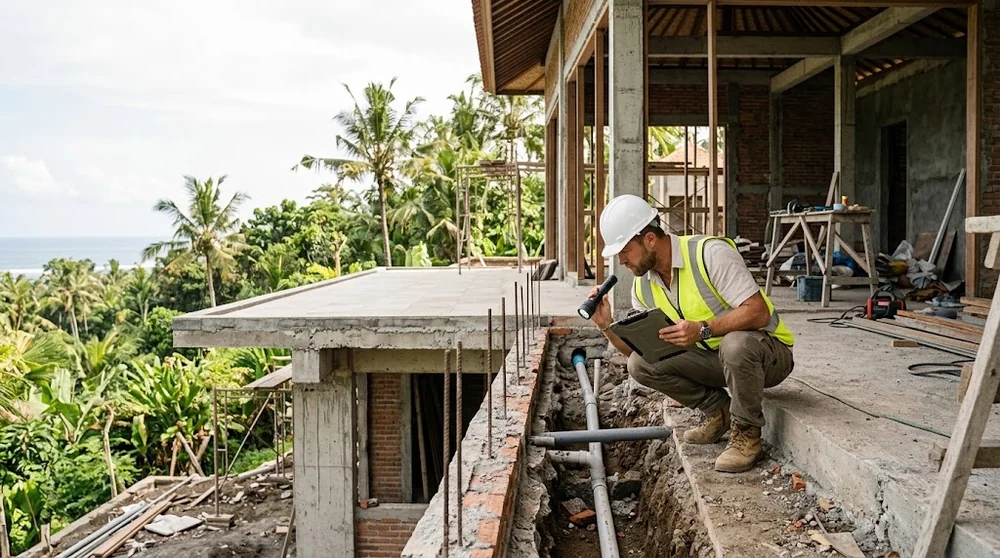
The safest way to commit money is in stages, with each payment tied to something independently verified. There’s no universal timeline for a Bali purchase, so negotiate dates that suit the property and the checks it needs. A sensible sequence looks like this:
- Preliminary checks: identity of the seller, a copy of the certificate, location, access and coastal setting.
- Conditional reservation: a deposit agreement reviewed by your lawyer, with refund triggers if checks fail.
- Deeper verification: land office search, building approvals, zoning, boundaries and technical inspection.
- Final documents: the lease or transaction deed, signed before the appropriate notary or PPAT.
- Milestone payments: released only on evidence such as an independent inspector’s report.
- Inspection and handover: defects listed, SLF confirmed before occupation or operation, final payment released.
Buying a completed villa
With a completed villa, you can inspect what exists. Ask a technical inspector to check structure, drainage, electrics, water, wastewater and corrosion, and compare the building against its PBG or valid legacy building permit. Confirm the SLF is in place before you or any guests use the villa. Your final payment should follow verified documents and an agreed defects list. You may be able to negotiate a retention, meaning a portion held back until listed defects are fixed.
Buying an off-plan villa
With an off-plan villa, you’re paying for something that doesn’t exist yet. Photographs or progress messages alone do not prove legal compliance or justify release. Tie each instalment to an inspector’s report, set a long-stop completion date and define what happens on delay: compensation, an extension or a right to terminate and recover funds. Make the SLF a condition of handover, not an afterthought. A defects period and a negotiated retention give the developer a reason to finish properly. Remember that staged payments still add up to the full price.
If you’d like a second set of eyes on a payment schedule before you commit, it’s often easier to talk it through than to trade long emails across time zones.
Got a reservation form or payment schedule in front of you? Message me on WhatsApp and I’ll tell you which questions to take to your lawyer before you pay anything.
A quick chat won’t replace legal advice, but it can stop you sending money before the basic checks are done.
Will the Holiday Home Fit Your Actual Life?
Before you pay anything, ask how often you will really visit. A villa you use for three weeks a year is a very different proposition from one you visit every school holidays. Think about the wet season, typically around November to March, when heavy rain can affect roads, terraces and outdoor living. Consider privacy, the neighbouring plots that may be built on, and how much construction noise you’d tolerate on a short break. Travel access matters too: the drive from the airport to your area at the times you usually arrive.
Running my own rental villa has made one thing very clear to me: the costs keep arriving whether or not guests do. Pools, gardens, air-conditioning and coastal metalwork need attention while you’re back home in Australia or New Zealand, so reliable local management is a necessity rather than a luxury.
If you plan to rent the villa, owner stays have an opportunity cost. The weeks most Australian and New Zealand families want, such as the Christmas period and school holidays, are often the weeks guests would book. Every peak night you spend there is a night you can’t rent. Rental activity also needs its own legal basis. A lease or land right does not by itself authorise a holiday-accommodation business, and it does not grant visa or residence rights. Licensing, tax registration and immigration status are separate questions for your lawyer and tax adviser, checked as of the transaction date. Visa and stay permit rules are published by Indonesian Immigration (Imigrasi), and Aussie and Kiwi owners should also check how foreign rental income is treated at home with the Australian Taxation Office or Inland Revenue (IRD) in New Zealand.
When you look at projections, separate gross yield from net yield, and build both from the same base. Start with gross rental income: the nights you can realistically expect to fill, multiplied by the rates you can actually achieve, after your own stays are taken out. Vacancy is already reflected there, so don’t deduct it again. Gross yield is that income divided by your chosen denominator. Net yield takes the same income, deducts the money you actually spend (management, maintenance, utilities, platform fees and relevant taxes) and divides by the same denominator. I prefer total acquisition cost, meaning the price plus purchase costs and fit-out, rather than the price alone, because that’s what you’ve really put in; whichever you choose, use it for both figures so the comparison is honest. Rental income should never be assumed; treat any projection as a scenario that needs verified local evidence.
My honest take: buy a villa you’d be happy to own even in a quiet rental year. If the purchase only works when every peak week is booked, the numbers are too tight.
If you’re still working out whether a Bali holiday home suits your budget and the way you actually travel, a few structured questions can help you see it more clearly.
Not sure whether a Bali villa fits your plans yet? Take my short buyer quiz to test your budget, visit pattern and rental expectations before you talk deposits.
Whatever your answers, the next step is the same: work through the checklist below before any money moves.
Your Checklist Before Sending the Deposit
Run through this list with your adviser before the money leaves your account. Any unresolved item should either stop the payment or be covered by a written condition that prevents release.
- Named property and parties: the exact villa or plot, and a seller or lessor with documented authority.
- Lawful structure: leasehold, Hak Pakai or PT PMA/HGB, with no nominee shortcut.
- Preliminary title and access checks: certificate copy, encumbrances and legal road access.
- Coastal and permit plan: local zoning, sempadan pantai review, PBG or valid legacy permit, SLF before occupation or operation, and intended use.
- Lease clock: start date, expiry, remaining years, construction time and extension pricing.
- Independent adviser: an Indonesian property lawyer acting only for you.
- Signed refund and release terms covering failed checks, default, delay and insolvency.
- Verified account: holder confirmed by independent callback and written confirmation.
- Funded balance: the remaining price, extra costs and currency spreads all budgeted.
- Payment file: contract, holding instructions, account confirmation and receipt saved together.
If an unverified recipient account, an unidentified seller, an unclear lease start date or a missing refund clause is still open, wait. A good villa will still be a good villa after proper checks, and a contract that can’t survive scrutiny isn’t one to fund. Get independent Indonesian legal advice, a technical inspection and tax advice before paying.
Bali Property Deposit FAQs
What does a 10% deposit on Bali property actually secure?
A 10% deposit may reserve a specific villa, fix an agreed price for a stated period or count towards the transaction price. The signed agreement determines its purpose and conditions. Paying it does not itself transfer land rights, complete a lease or confirm that the property has lawful beachfront access.
Is a booking fee refundable in Bali?
A Bali booking fee is not automatically refundable or non-refundable simply because of its name. Check the applicable law and signed terms for failed due diligence, seller default, buyer withdrawal, notice requirements and deductions. Ask an independent Indonesian lawyer to confirm the refund mechanism before payment, including who must return the funds and when.
Who holds the deposit when buying a villa in Bali?
The agreed recipient may be the seller, developer or a separately appointed payment holder. A notary does not automatically provide protected escrow. Verify the account holder, independence, written holding instructions and release conditions. Your lawyer should explain what happens to unreleased funds if the deal fails, the parties dispute release or the holder becomes insolvent.
What should I check before paying a Bali villa deposit?
Check the identified property, seller or lessor authority, underlying certificate, legal access, intended use and relevant approvals. For coastal property, verify local shoreline restrictions and physical risks. Review the remaining lease term, refund clauses, payment schedule and recipient account independently. Unfinished checks should be addressed through clearly reviewed conditions rather than verbal promises.
Can foreigners buy a beachfront villa in Bali?
Foreign buyers may acquire suitable contractual or legally permitted property rights, but foreign individuals cannot directly hold Hak Milik freehold land. The appropriate route depends on eligibility, property type and intended use. Beachfront marketing adds no special ownership entitlement: coastal planning, lawful access, building approvals and any rental permissions still require separate verification.
What happens after the initial deposit on an off-plan Bali villa?
Further payments follow the agreed contract and may be linked to document completion, construction milestones and handover. Confirm whether the initial deposit is credited towards the price and calculate every cumulative payment. Require suitable evidence before release and review delay, defect and termination clauses. Developer instalments do not remove the obligation to fund the remaining price.
Fazit: The Bottom Line on Your 10% Deposit
Nine years in Bali have taught me that the deposit is where good purchases are protected or quietly put at risk. The 10% itself is just a number a seller picked. What matters is what the paper behind it says: which property, which land right, which account, which conditions and which way back out if the checks fail.
Treat the deposit as the first step of a contract, not the end of a daydream. Verify the title with the land office, test the coastal and permit position, budget the full price plus costs and currency, and only send money to an account you’ve confirmed yourself. Do that, and the terrace, the coffee and the surf report are far more likely to stay a pleasure rather than become a dispute.
General information only: this article reflects Jack’s practical views and was prepared in October 2026. The regulations named (the Basic Agrarian Law of 1960, PBI 17/3/PBI/2015, PP 18/2021, PP 16/2021, PP 12/2021 and Perpres 51/2016) are identified by their official titles and issue years; their current amendment status has not been independently confirmed for this article and must be checked by your lawyer as of your transaction date. It is not legal, tax, financial or immigration advice, and laws, rates and procedures can change. Before paying any deposit or signing any agreement, consult an independent Indonesian property lawyer, the appropriate notary or PPAT, a qualified technical inspector and a tax adviser familiar with your circumstances in Indonesia and your home country.